October 13, 2026
·
Updated November 6, 2026
·
14 min read
Testimonial Release Form: Template and What It Won't Cover
A plain-English testimonial release form template, what each clause does, checkbox vs signed release, video and minors, and what a release can't cover.

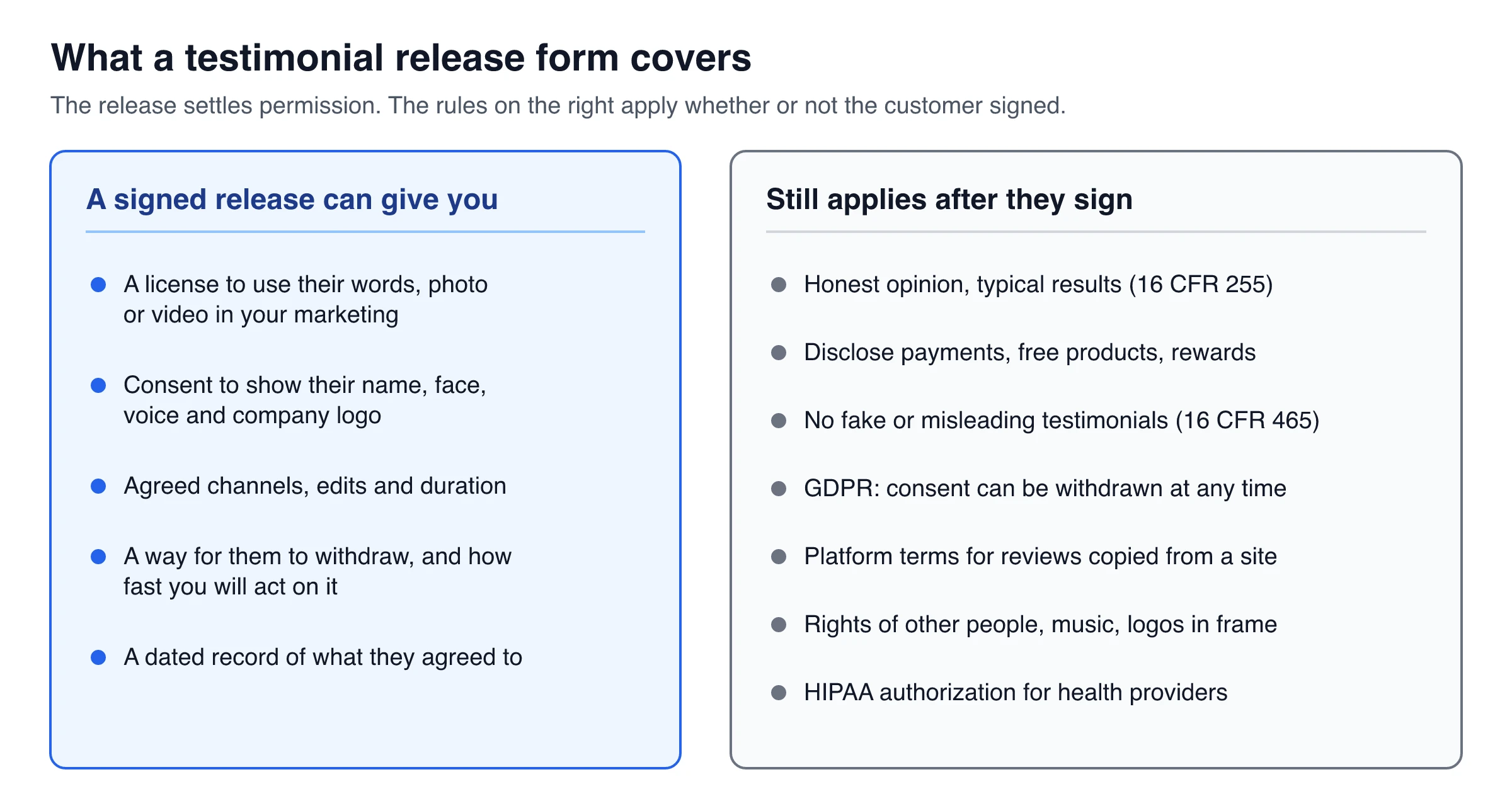
A testimonial release form is a short agreement in which a customer gives your business permission to use their testimonial in marketing: their words, and if they agree, their name, photo, company logo or video. A usable one answers seven questions in plain language: what content it covers, how the person is identified, where you may use it, how you may edit it, how long the permission lasts, how they can withdraw it, and whether they received anything in return.
Below is a copy-ready sample template, what each clause does, when a checkbox or an email is enough, the extra steps for video and minors, and the limits: what a signed release does not cover. This is general information, not legal advice. Have a lawyer adapt the form if you work in health care, finance or another regulated field, or outside the US.
What is a testimonial release form?
A testimonial release (also called a testimonial consent form) bundles two permissions that are easy to treat as one:
- A license to the content. The customer usually owns the copyright in the words they wrote and the video they recorded. The release lets you reproduce, shorten and adapt it.
- Consent to use their identity. Using someone’s name, photo, face or voice to sell something is protected in many places, as a right of publicity in US states and as personal data under privacy laws such as the GDPR. The release records that they agreed.
The form is also where you write down the practical terms: channels, edits, duration and withdrawal. That record is what you go back to when someone asks, a year later, why their face is in your ad.
You don’t always need a formal document. For a short written quote on your own website, a clearly worded permission checkbox on your collection form or a written “yes” to a specific request is common practice. The guide on how to ask customers for permission to use a testimonial has request wording for that. The fuller release below is worth the extra step for photos, video, paid ads, case studies and anything involving a minor.
Testimonial release form template (plain-English sample)
Copy the text, replace the bracketed parts and delete the options you don’t use. It’s written so a customer can read it in a couple of minutes. For an online form, the checkboxes become tick boxes and the signature line becomes an “I agree” box plus a typed name.
Testimonial release
1. Who and what. I, [full name], give [business legal name] (“you”) permission to use the testimonial I provided on [date] (the “Testimonial”). The Testimonial includes:
☐ my written statement, as approved below
☐ my photo
☐ my video and voice recording
☐ my company name and logo2. How I’m identified. You may identify me as:
☐ my full name
☐ my first name and last initial
☐ my job title and company
☐ no name (“a customer in [industry]”)3. Where you may use it.
☐ your website and product pages
☐ your social media accounts
☐ email newsletters
☐ sales presentations, proposals and case studies
☐ paid advertising (online, print, video)
☐ printed materials and events4. Editing. You may shorten the Testimonial, fix spelling and grammar, crop images, trim the recording and add captions or translations, as long as the result does not change what I meant. Words shown in quotation marks will be words I said or wrote. You will ask me before making any other change.
5. How long. This permission lasts ☐ until I withdraw it ☐ for [number] years from the date below. If I tell you my experience has changed, you will stop presenting the Testimonial as current.
6. Withdrawing permission. I can withdraw this permission at any time by emailing [address]. Within [number] business days you will stop new uses and remove the Testimonial from websites, social accounts and ads you control. You do not have to recall printed materials distributed before you received my notice.
7. Payment and honesty. The Testimonial reflects my honest opinion and my own experience.
☐ I have received nothing in return for it.
☐ I received [describe: discount, gift card, free month, free product, payment]. You will disclose this wherever the Testimonial appears.
Nothing I received depended on my Testimonial being positive.8. My rights. This is a non-exclusive, royalty-free permission. I keep ownership of my words and recordings and remain free to share my opinion anywhere, including on public review sites.
9. My data. You will store my name, contact details and the Testimonial to manage this permission, as described in your privacy notice: [link].
10. Minors. If the person featured is under 18 (or under the age of majority where they live), a parent or legal guardian signs below on their behalf.
Approved testimonial: [paste the exact final text, or the video file name and length]
Name: ________ Signature (or ☐ I agree): ________ Date: ________ Email: ________
Parent or guardian, if the person featured is a minor: Name: ________ Signature: ________ Date: ________
Some free templates make the release “irrevocable” and “perpetual.” That is convenient for the business, but if you rely on consent under the GDPR, the person can withdraw it at any time, and a testimonial that no longer reflects the customer’s experience creates its own advertising problem. A withdrawal clause plus a periodic review is usually the safer default.
What each clause does and why it’s there
| Clause | What it settles | Why it’s there |
|---|---|---|
| Who and what | Exactly which content you may use | A photo or video carries identity rights a text quote doesn’t. Ticking each item avoids “I only agreed to the quote.” |
| How I’m identified | Name format or anonymity | Some customers are happy to be quoted but not named, or named but not photographed. |
| Where you may use it | Channels | Paid ads and sales decks reach audiences the customer may not expect, so ask for them by name. |
| Editing | What you may change | The FTC Endorsement Guides say an endorsement may not be “reworded so as to distort” the endorser’s opinion, and quotation marks signal the endorser’s exact words (16 CFR 255.1(b)). |
| How long | Duration and accuracy | When an ad says the endorser uses the product, you may keep running it only while you have good reason to believe they still do (16 CFR 255.1©). |
| Withdrawing | Process and timing | Under the GDPR, consent can be withdrawn at any time, and withdrawing must be as easy as giving it (Art. 7(3)). |
| Payment and honesty | Material connections | Payment, free or discounted products and even the chance of winning a prize are connections that must be disclosed clearly when the audience wouldn’t expect them (16 CFR 255.5). |
| My rights | Type of license | The Consumer Review Fairness Act voids form-contract terms that require customers to hand over IP rights in their reviews, with an exception for a non-exclusive license (15 U.S.C. § 45b). An assignment or exclusive license of copyright also needs a signed writing (17 U.S.C. § 204(a)). |
| My data | Transparency | Names, emails and photos are personal data. Tell people where you keep them and why. |
| Minors | Who can consent | California’s right-of-publicity statute makes anyone who knowingly uses a minor’s name or likeness in advertising without the prior consent of their parent or legal guardian liable for damages (Cal. Civ. Code § 3344). |
Is a checkbox or email enough, or do you need a signed release?
In the US, an electronic signature or record “may not be denied legal effect” just because it is electronic (15 U.S.C. § 7001). A ticked box, a typed name or a reply email can therefore count, as long as you can later show who agreed, to what wording, and when. Where a law requires a record to be kept, the electronic version must be one that can be retained and accurately reproduced later.
The format matters less than the scope and the record. One way to match the effort to the risk:
| How you’ll use the testimonial | Reasonable minimum | Why step up |
|---|---|---|
| Short text quote, first name, your own website | A permission checkbox with clear wording, or a written yes to a specific request | Low reach and easy to remove |
| Full name, photo, company logo, social posts | A checkbox or email that names these items and channels | Identity use. A company logo may need the company’s OK, not just the employee’s. |
| Video, paid ads, case studies, print | The full release above, signed electronically or on paper | Wider reach, costly to re-edit, harder to pull back |
| Minors, patients, clients of regulated professions | The full release plus the sector’s own rules | Parental consent, HIPAA authorization or professional advertising rules apply |
Whichever format you use, keep the exact wording each person agreed to. If you change your checkbox text or your template, save the old version with the dates it was in use.
Video testimonial release forms and minors
A video testimonial puts more on record than a quote: a face, a voice, often a home or office, sometimes other people. Add these points to the base template:
- Everyone identifiable consents. A colleague in the background or a family member on camera needs their own permission. The customer’s signature doesn’t cover them.
- Check the background. Music playing, posters, screens and other brands’ logos can belong to someone else. Mute, crop or re-record rather than relying on the customer’s release.
- Recording is not publishing. Agreeing to record is not the same as approving every take. Show the customer the final cut, or name it in the release, before it runs.
- Captions and translations must match. The editing clause covers them, but they have to say what the person said.
- Minors need a guardian’s signature. A parent or legal guardian signs for anyone under 18. Some organizations use a higher age, so check the rule where you operate. In California, using a minor’s name or likeness in advertising without a parent’s or guardian’s prior consent creates liability under § 3344. Ideally the guardian is present during recording.
- Store the signed release with the video file. If the clip is reused in an ad six months later, whoever builds the ad should be able to find the release in one step.
What a testimonial release form doesn’t cover
A release answers one question: may you use this person’s words and identity? It leaves the rest of advertising law, privacy law and platform rules exactly where they were. The permission guide mentioned earlier covers the FTC side in more depth. Here is the condensed version.
Truthfulness and typical results
An endorsement must reflect the endorser’s honest opinion and can’t convey anything that would be deceptive if you said it yourself (16 CFR 255.1(a)). You also need your own evidence for the claims it makes: the FTC says consumer endorsements “are not competent and reliable scientific evidence.” If a testimonial describes a result on a key attribute, readers will likely take it as typical. Unless it is, disclose the generally expected result clearly and conspicuously, in a way that changes the overall impression (16 CFR 255.2).
Quick test: highlight every number and outcome in the quote (time saved, revenue, weight lost) and ask what file you would show to back it up.
Rewards and other material connections
The release can record that the customer got a discount or gift card, but the disclosure has to travel with the testimonial itself, wherever it appears. A thank-you coupon is still a connection, so if you offer testimonial rewards, plan where the disclosure goes. If you also ask customers for public reviews, the FTC’s review rule bans providing compensation or other incentives conditioned on the review expressing a particular sentiment, positive or negative (16 CFR 465.4).
Fake or reworded testimonials
A signature from someone who never used the product, or for words you wrote for them, protects nothing. The FTC’s rule on consumer reviews and testimonials, in effect since October 21, 2024, prohibits creating a testimonial that misrepresents who gave it or what their experience was, and covers businesses that disseminate testimonials they knew or should have known were misleading (16 CFR 465.2). Rewriting a customer’s quote into your own marketing copy and asking them to “approve” it drifts toward a fake review. Edit lightly instead.
Withdrawal under privacy law
If consent is your legal basis under the GDPR, an “irrevocable” clause doesn’t stop the person from withdrawing, and withdrawing must be as easy as agreeing. Plan for it: keep a list of every page, ad, email sequence and sales deck where each testimonial appears, so removal takes minutes. A testimonial removal workflow is worth setting up before the first request arrives.
Reviews copied from Google and other platforms
A reviewer can give you permission to use their own words, but that permission doesn’t override any contract you have with the platform. If you pull reviews through Google’s Maps Platform APIs, for example, its terms (last modified August 26, 2026) say customers will not “copy and save business names, addresses, or user reviews” (section 3.2.3). Use the platform’s own embedding options, or ask the reviewer to submit a fresh testimonial to you directly. The checks for showing Google reviews on your website cover this in detail.
Other people’s rights inside the photo or video
The customer can license their own words and image, not a coworker’s face, a song playing in the background, a screenshot of someone else’s software or a client’s logo. Those need separate permission or an edit.
Health care and other regulated fields
A HIPAA covered entity generally needs a HIPAA authorization before using a patient’s protected health information in marketing (45 CFR 164.508(a)(3)). That authorization has required elements a generic release usually lacks, including the purpose, an expiration date or event, and a statement of the right to revoke in writing. Lawyers, financial advisers and other licensed professions often have their own advertising rules too.
Review-suppression clauses
A release must not double as a gag clause. If your template, or the terms of sale it’s attached to, restricts honest reviews, penalizes negative ones or claims ownership of review content, those terms can be void under the Consumer Review Fairness Act. Quick test: search your template for “non-disparagement,” “remove,” “take down,” “penalty,” “fee” and “must be approved.” Rewrite any hit before you collect another signature.
Using a form checkbox instead of a separate release
If you collect testimonials through a form, the permission can live in the form itself. On a ShowTrust collection page, the permission checkbox has three modes: Don’t ask, Optional or Required. You write the checkbox text, up to 300 characters of plain text. The default reads “I give permission to use this testimonial on the website and social media.” Each testimonial records whether the box was ticked, you see that while reviewing, and the permission flag is included in the CSV export.
Sample checkbox text that fits the limit:
I agree that [Business] may publish this testimonial with my name, role, company and photo on its website, social media, emails and ads, edited only for length and typos. I can withdraw this any time by emailing [address].
What the checkbox doesn’t do, so you can fill the gaps:
- It records yes or no, not the wording. Keep a dated copy of your checkbox text each time you change it.
- One box, one scope. There are no per-channel options, no signature field and no guardian sign-off. For video in paid ads, or anything involving a minor, send the full release separately.
- Imports carry no consent. Testimonials you import from an X post, pasted G2 or Trustpilot text or a CSV have no permission record. Ask those customers directly.
- One approver. Approval is the account owner moving a testimonial from Pending to Approved. There are no team roles or audit trail.
- Video is a Pro feature. Video testimonials are recorded in the browser or uploaded on the Pro plan. ShowTrust doesn’t add captions or transcripts, so if you caption a clip yourself, the editing clause applies.
Go/no-go checklist before you publish a testimonial
Run this before any testimonial goes live, signed release or not:
- Scope: the permission covers this exact quote or video, this name format and this channel.
- Claims: every number and outcome is true and typical, or paired with the generally expected result.
- Disclosure: any reward, discount, free product or relationship is disclosed next to the testimonial.
- Authenticity: the person is real, the words are theirs and your edits didn’t change the meaning.
- Source: reviews from another platform are shown in a way that platform allows.
- People in frame: everyone identifiable consented, and a guardian signed for any minor.
- Removal: you know every place it’s published and can take it down quickly if they withdraw.
Use the template, then check the limits
Use the full release for anything beyond a short text quote on your own site, keep the wording each person agreed to, and give people a real way to withdraw. Then treat accuracy, disclosure and platform rules as separate checks you run before every testimonial goes live, because a signature doesn’t settle any of them.
Frequently Asked Questions
- Is a testimonial release form legally binding?
- It works like any other agreement or consent record: it is as strong as its wording and your proof of who agreed, to what, and when. In the US, a signature or record can't be denied legal effect just because it is electronic (15 U.S.C. 7001). Rules differ by country and state, so ask a lawyer if a dispute looks likely.
- Can a customer take back permission after signing a release?
- Often, yes. If you rely on consent under the GDPR, the person can withdraw it at any time. Even where a release could be made irrevocable, keeping a former customer's face in your ads against their wishes rarely ends well, so include a withdrawal clause and a removal process.
- Do I need a release for an anonymous testimonial?
- You still need permission to use the words, because the customer usually owns the copyright in them. You don't need consent for a name or photo you aren't showing. Check that details such as a job title at a small company don't identify the person anyway.
- Can I put a Google review on my website without asking?
- The reviewer's permission and the platform's terms are separate questions. If you get reviews through Google's Maps Platform APIs, its terms forbid copying and saving user reviews, so use a display option the platform allows or ask the reviewer to send you a testimonial directly.
- Can I edit a testimonial after the customer signs the release?
- Only as the editing clause allows. Fixing typos and trimming length are normal. The FTC Endorsement Guides say an endorsement may not be reworded to distort the endorser's opinion, and words in quotation marks should be the person's exact words. For anything more, ask again.
- Does a parent have to sign a release for a minor's testimonial?
- In practice, yes. Get the signature of a parent or legal guardian for anyone under 18. California's right-of-publicity statute, for example, requires a parent's or guardian's prior consent before a minor's name or likeness is used in advertising.
ShowTrust’s collection page can show a permission checkbox with your own wording, set to Optional or Required, on the Free plan (1 project, unlimited testimonials). Pro, at $4.99/month or $49.99/year per project slot, adds video testimonials and white-label.
Written by
ShowTrust
Notes from the ShowTrust team on collecting testimonials and building authentic social proof.
Share: