August 14, 2026
·
Updated November 6, 2026
·
15 min read
No Credit Card Required vs Card Upfront: Which Converts?
This guide explains what “no credit card required” means, compares opt-in and opt-out free trials on signups, paid conversion, refunds and abuse, and shows what each published benchmark actually measured. It also covers the US rules for card-upfront trials as of November 2026, copy for both signup flows, and a test plan for deciding.

Asking for a card upfront gets fewer people to start a free trial, but a much bigger share of them end up paying. A 2026 ChartMogul survey of 200 software products found that card-required trials converted 30% of signups to paid, more than five times the rate of trials with no credit card required. Whether that leaves you with more paying customers is a different question: the two most recent benchmarks disagree, so the reliable answer comes from measuring paid customers per visitor on your own traffic.
What does “no credit card required” mean?
“No credit card required” means you can create an account and use the product without entering a card or any other payment method. It describes how you start, not what you get: the offer behind it can be a time-limited free trial, a free plan with no end date, or a limited demo.
Because no payment method is on file, nothing can be charged automatically when the free period ends. To keep using paid features, you choose a plan and add payment details yourself.
You usually still give an email address and a password or single sign-on. Some business tools also ask for a work email, a company name or a phone number, mainly to cut down on throwaway accounts and to route serious leads to sales.
Free trial vs free plan vs demo
The phrase sits on very different offers. Check which one you are looking at before comparing conversion numbers.
| Offer | How long | Card at signup | What happens at the end |
|---|---|---|---|
| No-card free trial (opt-in) | Fixed window | No | Access stops, or drops to a free tier, until you pick a plan |
| Card-upfront free trial (opt-out) | Fixed window | Yes | Converts to a paid plan and charges the card unless you cancel |
| Paid trial | Short window at a low price | Yes | Converts to the full price unless you cancel |
| Reverse trial | Paid features for a fixed window | Usually no | Paid features switch off; the account stays on a free plan |
| Free plan (freemium) | No end date | Usually no | Nothing ends; usage or feature limits prompt an upgrade |
| Demo or sandbox | One session or sample data | No | No ongoing access to your own work |
Trials are usually short. In the 2026 ChartMogul and ProductLed survey covered below, 62% of trial products used a 14-day trial, and 14% each used 7 or 30 days.
Can a no-card trial charge you later?
Not by itself. With no payment method on file, there is nothing to charge. A few situations look like exceptions:
- App store subscriptions. Apple and Google already hold your payment details, so an in-app free trial renews into a paid subscription unless you cancel in the store settings.
- A card you saved earlier with the same company, for example from an old subscription.
- Invoiced business plans, which bill by invoice instead of card.
- A “start trial” button that leads to checkout. If the next screen asks for a card, the offer is opt-out, whatever the landing page said.
When a no-card trial ends, check what happens to your data. Good products keep it for a stated period, show it read-only, or let you export it. Look for the retention period on the pricing page or in the help center before you put real work into a trial. The FTC’s consumer guide to getting in and out of free trials covers the card-upfront side: note the cancellation date and keep records when you cancel.
Opt-in vs opt-out free trials: the trade-off
In an opt-in trial, the user has to choose to pay when the trial ends. In an opt-out trial, the card is billed automatically unless the user cancels. The card field moves friction to a different point in the funnel, and each model pays for its strength somewhere else.
| No card (opt-in) | Card upfront (opt-out) | |
|---|---|---|
| Signups | More, because there is no payment step | Fewer, because the card field turns away casual visitors |
| Trial-to-paid rate | Lower, because every user has to decide to pay | Higher, because users who do nothing get billed |
| Who converts | People who chose to pay | Buyers, plus some people who forgot to cancel |
| Refunds and disputes | Few, since nobody is billed by default | More “I forgot to cancel” refunds and chargebacks |
| Abuse | Repeat trials from new accounts, bots | Card testing through the card-setup step |
| Sales follow-up | More leads, many with low intent | Fewer leads with higher intent |
| Rules | Lighter, since nothing renews automatically | Disclosure, consent, reminder and cancellation rules apply |
The trap is judging the two models on a single conversion rate. Trial-to-paid always looks better with a card, because the denominator shrinks and inertia adds conversions. The number that matters is paying customers per visitor, measured after the first few bills.
Abuse cuts both ways. Stripe’s free trial documentation warns that trials without a payment method let spammers create lots of fake customers, and suggests an account plus a captcha before the trial starts. A card gives fraud tools something to score: Stripe Radar’s free trial abuse control blocks high-risk trial starts before they convert. But a card step also creates a new target: Stripe’s card-testing documentation says fraudsters favor card-setup flows to check stolen cards, because validations there don’t usually show on cardholder statements.
Which converts better? What the published data says
Every source agrees that card-upfront trials convert a larger share of trial users. They disagree on net paying customers, which is the number that pays your bills. Four sources are worth knowing, along with their limits.
ChartMogul and ProductLed SaaS Conversion Report (2026)
Kyle Poyar’s SaaS Conversion Report with ChartMogul and ProductLed collected 200 survey responses in January 2026. A typical respondent had $1–10 million in annual recurring revenue, and conversion meant signups who paid within six months.
- 20% of free-trial products required a card upfront; 80% did not.
- Card-required trials converted 30% of signups to paid, more than five times trials without a card.
- The report calls 25–35% “good” and 50–60% “great” when a card is required.
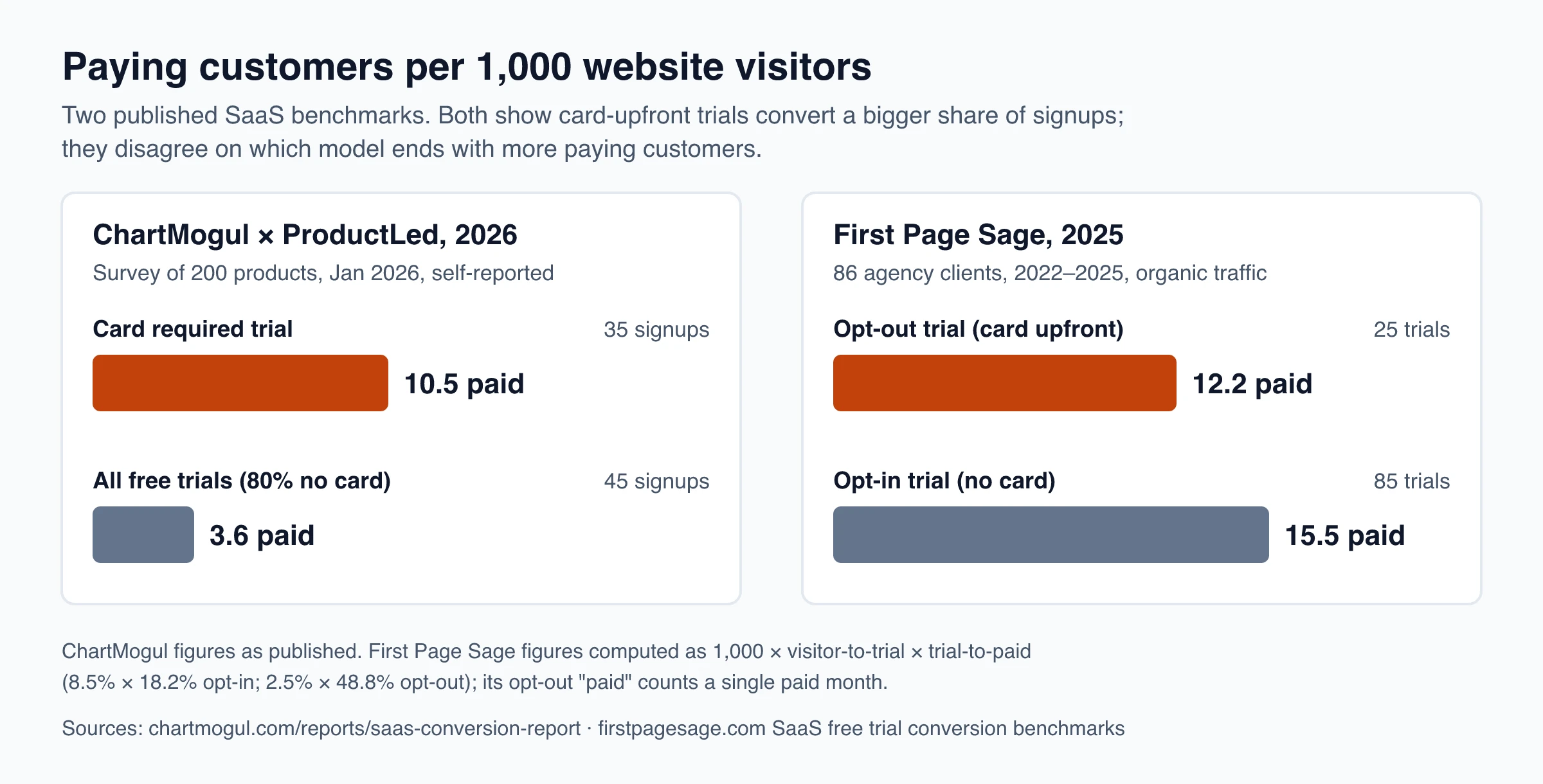
- Per 1,000 website visitors, card-required trials produced 35 signups and 10.5 paying customers. Free trials overall produced 45 signups and 3.6 paying customers.
Limits: traffic figures are respondents’ own estimates, the sample gets small once it is split by business model, and the report doesn’t break out no-card trials on their own: its free-trial figures cover the whole trial category, in which 20% of products require a card.
First Page Sage benchmarks (2025)
First Page Sage, a marketing agency, published benchmarks in September 2025 based on 86 of its own SaaS clients (71% B2B) from early 2022 to late 2025. For organic traffic:
- Opt-in trials: 8.5% of visitors start a trial, and 18.2% of trials convert to paid.
- Opt-out trials: 2.5% of visitors start a trial, and 48.8% of trials convert to paid.
Multiply through and opt-in trials produce about 15.5 paying customers per 1,000 visitors, against about 12.2 for opt-out. That is the opposite of ChartMogul’s net result.
Limits: it reflects one agency’s clients, the page says only that it aggregated client data, without further method detail, and an opt-out conversion counts “even a single paid month,” which flatters the card-upfront number.
Lenny’s Newsletter benchmark (2023)
The August 2023 benchmark by Kyle Poyar and Lenny Rachitsky drew on more than 1,000 products, mostly B2B SaaS, surveyed with OpenView and Pendo. It calls 8–12% a good free-trial conversion and 15–25% great. For self-serve freemium, 3–5% is good and 6–8% great. It doesn’t split trials by card requirement, but it gives a sanity check for an opt-in trial.
A field experiment on auto-renewal (academic)
The closest randomized evidence comes from outside SaaS. Klaus Miller, Navdeep Sahni and Avner Strulov-Shlain randomly assigned more than 2 million readers who hit a European newspaper’s paywall to promotional subscriptions that either auto-renewed or auto-cancelled (working paper). As summarized by Stanford GSB in 2023:
- Auto-renewal produced a 20% higher subscription rate over the first four months.
- After one year, revenue from the two contract types was equivalent.
- After two years, auto-renewal offers had produced about 10% fewer subscribers, and many auto-renewed subscribers rarely read the paper.
It is a newspaper promotion, not a card gate on a software trial. But it isolates the inertia part of opt-out conversion: some extra “conversions” are people who never got around to cancelling, and that advantage fades.
Be wary of numbers like “opt-out trials convert at 50–60%, opt-in at 15–25%” when no report, sample or date comes with them. Many are repeated from studies more than a decade old. If you can’t find the method, don’t plan around the number.
The bottom line: card-upfront wins on trial-to-paid rate in every source. On paying customers per visitor the evidence is split. The result depends on how much the card field cuts signups on your traffic, and how many card-upfront conversions survive the second and third bill.
Should a free trial require a credit card?
Match the gate to your costs and your buyers.
Require a card upfront when:
- Each trial costs you real money: compute, AI or API usage, phone numbers, or human onboarding.
- Abuse is likely and expensive, for example free compute, outbound email or scraping.
- The product is high-priced or sold annually, and buyers arrive already comparing vendors.
- Buyers expect it. The ChartMogul report notes that users of serious products, or products that touch sensitive data, may expect a card requirement.
- You sell through app stores, where trials already renew automatically.
Keep the trial card-free when:
- People see value within minutes, so the product sells itself once they try it.
- Your brand is unknown and a card field reads as a risk.
- The price is low and most upgrades are self-serve.
- You use product usage to decide which accounts sales should call.
- You aren’t ready to run the reminder emails, cancellation flow and refund handling that card-upfront trials need.
Middle paths
You don’t have to pick one extreme.
- Card at the moment of value. No card to start; ask for one at a usage limit, a premium feature or when a second teammate joins.
- Reverse trial. Full features for a fixed period with no card, then the account drops to a free plan instead of locking.
- Paid trial. A small first charge filters for intent and makes billing explicit. Stripe’s trial offers support this, with “1 USD for the first week” as an example.
- Free plan, no trial. ShowTrust, a testimonial tool, works this way: its Free plan costs $0 with no card and no end date, and Pro ($4.99/month per project slot) is an upgrade you choose rather than a trial that converts.
- Lighter checks instead of a card. Verified email before costly features, rate limits on expensive actions, and extra steps only for risky signups.
Rules for card-upfront trials (US, as of November 2026)
This is a summary, not legal advice. If you bill a card automatically after a free period, several layers of rules apply.
The FTC’s click-to-cancel rule is not in force
The FTC’s 2024 amendments to its Negative Option Rule, known as “click to cancel,” were struck down before their main requirements applied. The Eighth Circuit vacated them on July 8, 2025, on procedural grounds, days before the July 14 compliance date. On February 12, 2026, the FTC published a final rule restoring the earlier text, which covers only prenotification plans.
The FTC then restarted the process with an advance notice of proposed rulemaking, published March 13, 2026. Comments closed April 13, 2026. As of early November 2026, no proposed rule has been published, so there is no federal click-to-cancel rule in force. Covington’s summary explains what the notice asks.
ROSCA still applies
The Restore Online Shoppers’ Confidence Act covers online sales with a negative option feature, which includes a free trial that turns into a paid plan. It requires you to:
- Clearly disclose all material terms before you take billing information.
- Get the customer’s express informed consent before charging.
- Provide a simple way to stop recurring charges.
The FTC still enforces it. In September 2025, Amazon agreed to a $2.5 billion settlement ($1 billion civil penalty and $1.5 billion in refunds) over Prime enrollment and cancellation, in a case brought under the FTC Act and ROSCA.
State automatic-renewal laws
Many states have their own automatic-renewal laws. California’s amended law applies to contracts made, amended or extended from July 1, 2025, and explicitly covers free-to-pay conversions. According to a Kelley Drye summary, it requires express affirmative consent to the renewal terms, consent records kept for at least three years, and cancellation through the same medium the customer used to sign up. If you show a retention offer online, a cancel button has to appear at the same time. The list keeps growing: a 2026 roundup by the same firm covers a New York City rule in effect from October 1, 2026, and Louisiana’s Click to Cancel Act from January 1, 2027, which requires a notice at least three days before a free trial converts. Check the rules in the states and cities where your customers live.
Visa and Mastercard free-trial rules
Card networks add requirements of their own. Visa’s policy for free trials and introductory offers, in force since April 18, 2020, applies when you collect a card for a trial that rolls into a subscription:
- Get express consent at enrollment, then send an electronic confirmation of the terms (start date, amount, billing frequency and an online cancellation link), even when nothing is due today.
- Send a reminder with the amount, date and a cancellation link at least seven days before the first post-trial charge. If the trial is shorter than seven days, put those details in the initial confirmation.
- Let cardholders cancel online, however they signed up.
- Add a trial marker such as “trial” or “free trial” to the statement descriptor of the first post-trial charge.
The seven-day reminder and online cancellation are still in the Visa Core Rules edition dated October 24, 2026.
Mastercard’s rules, announced in January 2019, target free trials of physical products. The merchant must get the cardholder’s approval before the first charge and send the amount, date and cancellation steps.
Billing platforms can do much of this for you. Stripe’s trial compliance settings, for example, send a reminder 7 days before a trial ends and add “TRIAL OVER” text to the statement descriptor.
What to say on the signup and pricing page
Whichever model you choose, state what happens today, what happens later, and how to stop it. Users who have to guess assume the worst. Replace the bracketed parts with your real terms, and only use a line if it is true.
No-card trial copy
- Button: “Start free trial — no credit card required”
- Under the button: “[14] days of full access. We only ask for payment if you choose a plan.”
- Plan boundaries before signup: “Free trial includes [X]. Paid plans add [Y].”
- When the trial ends: “Your trial has ended. Your work is saved for [30] days. Pick a plan to keep going.”
Card-upfront trial copy
- Button: “Start [14]-day free trial — card required, $0 today”
- Next to the card field: “No charge until [date]. We’ll email you [7] days before. Cancel anytime in Settings.”
- Confirmation screen: “Today: $0. On [date]: $[price]/month unless you cancel.”
- Show “today” and “later” prices in the same box, and keep the cancellation path one click away.
Avoid a reason that sounds like an accusation, such as “card required to prevent abuse.” If you need the card for fraud control, say what the user gets in return: no interruption when the trial ends.
Trust signals next to the signup button
A card field and an unknown brand raise the same question: is this safe? A short, specific trust signal near the button answers it better than a badge in the footer. Options include a rating summary, one relevant customer quote, a security note or a plain refund line.
Testimonial tools can supply the proof. ShowTrust, for example, offers a rating badge that links to a public testimonial page and a single-testimonial embed meant for pricing, checkout or signup pages. Whether proof changes your signup rate is something to test, not assume. For placement ideas, see how testimonials on pricing pages are usually arranged.
How to A/B test the card requirement
A clean A/B test of the card field is slower than a button-color test, because the result arrives weeks after the visit.
- Pick the metric that pays. Use paying customers per 1,000 visitors who are still paying at day 90, or revenue per visitor. Don’t use signups or trial-to-paid rate.
- Set guardrails before you start. Track refund rate, chargebacks, billing tickets, bot or duplicate signups, activation rate and early churn.
- Randomize visitors, not signups. Assign the variant before the pricing or signup page, so both arms see the same traffic mix.
- Wait for the second bill. The test runs for enrollment, plus the trial length, plus at least two billing cycles. Early card-upfront conversions include people who cancel after the first charge; SaaS consultant Lincoln Murphy suggested counting them only after 60–90 days back in 2013.
- Size it on paid customers. Paid conversions run at a few per 1,000 visitors, so you need far more traffic than a signup test. As an illustration, detecting a 30% lift from 3.6 to 4.7 paid per 1,000 visitors (5% significance, 80% power) takes about 54,000 visitors per variant.
- Segment the result. Split by channel, company size, country, device and returning trialists. One segment often drives most revenue.
- Decide with a rule written in advance. For example: switch to card-upfront only if day-90 paid customers per visitor rise and refunds and chargebacks stay under your threshold.
If you can’t reach that sample in a reasonable time, a time-boxed switch with cohort comparison is the fallback. Watch seasonality and channel mix, which can fake a win. Use funnel analysis to see where each variant loses people, and line up your landing page proof before the test so both arms get the same page.
The short answer
Card upfront converts more of the people who start a trial. No card brings in more people. Which nets more paying customers depends on your traffic, price and costs, and the best public data is split.
- Define conversion as paying customers per visitor at day 90.
- Default to no card when value is fast and trust is low. Require a card when trials are costly or easy to abuse.
- If you take a card, meet ROSCA, state law and Visa or Mastercard rules: clear terms, consent, a reminder and easy cancellation.
- Test both on your own traffic, wait for the second bill, then decide.
Frequently Asked Questions
- What does “no credit card required” mean?
- It means you can sign up and use the product without entering a card or other payment method. The offer can be a time-limited trial, a free plan with no end date, or a demo. Because no payment method is on file, nothing renews into a paid plan automatically; you choose a plan and add payment details yourself if you want to continue.
- Can a free trial with no credit card charge you later?
- Not on its own, because there is nothing to charge. Watch for exceptions: app store trials (the store already has your payment details), a card you saved earlier with the same company, invoiced business plans, and “start trial” buttons that lead to a checkout page asking for a card.
- Do card-upfront free trials convert better?
- They convert a larger share of trial users. ChartMogul's 2026 survey found 30% trial-to-paid with a card, more than five times trials without one. They also get fewer signups, and benchmarks disagree on which model ends with more paying customers per visitor, so test it on your own traffic.
- Is a free plan the same as a free trial?
- No. A free trial gives access for a fixed period, often 14 days, and then ends or converts to paid. A free plan has no end date and limits features or usage instead. Both can be offered with no credit card required.
- Is the FTC click-to-cancel rule in effect?
- No. The 2024 amendments were vacated by the Eighth Circuit on July 8, 2025, and the FTC restored the old rule text in February 2026. It opened a new rulemaking in March 2026; as of early November 2026, no proposed rule has been published. ROSCA and state auto-renewal laws still apply to trials that bill automatically.
- Why do some no-card trials ask for a work email or phone number?
- Without a card, companies use other signals to reduce abuse and repeat trials and to decide which signups sales should contact. A work email or phone check makes throwaway accounts harder. If you only have a personal email, look for single sign-on or a contact-sales option.
ShowTrust’s Free plan collects unlimited written testimonials and displays them on your site with no card and no trial; it shows a small credit link you can switch off. Pro adds video and white-label for $4.99/month per project slot.
Written by
ShowTrust
Notes from the ShowTrust team on collecting testimonials and building authentic social proof.
Share: